
How New Hampshire’s State CIO delivered reliable digital services at scale

By mid-2021, New Hampshire ranked among the top U.S. states for COVID-19 vaccinations. Their registration system and downstream logistics were held up as an example of what was possible in public service delivery. But this great achievement didn’t come without hard work and challenges. Hear from New Hampshire State CIO Denis Goulet how his team delivered the tech that facilitated millions of vaccinations, and how Queue-it gave peace of mind for digital service delivery at scale.
Enabling citizen services through digital transformation. That’s the key strategy that’s motivated New Hampshire’s State CIO Denis Goulet and the Department of Information Technology (DoIT) for years.
Guided by values of transparency, reliability, efficiency, and collaboration, the state was awarded national recognition for their “citizen centric services” in the 2020 Center for Digital Government, Digital States Survey.
But even for a digitally mature state like New Hampshire, the COVID-19 pandemic put the DoIT and its digital public services to the test.
“It was a pretty crazy time,” says Goulet. “We had to move projects more quickly than we’ve ever done before. Take more calculated risks.”
Among the many technical challenges COVID posed, one stood out: the distribution of vaccination registrations. It involved digital public service delivery on an unprecedented scale.
Goulet and his team were key contributors in scoping, testing, and delivering the vaccination registration technology for New Hampshire’s 1.3 million citizens.
The project was hard work. It wasn’t without its ups and downs. But as New Hampshire Governor Chris Sununu said in a May 2021 press conference: “this is the best country in the world in terms of vaccine administration, really, and we're the best state in the country. So it's a lot to be proud of here. The system works very, very well.”
Discover how New Hampshire “became national leaders in vaccinations” and how Queue-it gave Goulet and his team peace of mind and control for high-stakes public service delivery at scale.
After facing issues with the federal Vaccine Administration Management System (VAMS) during phase 1 of the rollout, Goulet and his team collaborated with agencies and partners to develop the Vaccine & Immunization Network Interface (VINI) for phase 2.
Implementing VINI improved the citizen service experience by giving the state more control over the vaccination registration process. It let residents schedule appointments over the phone, as well as reschedule appointments without first cancelling their original appointment.
New Hampshire was well-positioned for phase 2 of the vaccination rollout. Goulet’s commitment to centralized government IT and citizen centric services meant the registration process for residents would be easy to navigate and straightforward.
But with vaccination websites crashing across the U.S. and around the world, the risk of delivering an unreliable citizen experience for this crucial service loomed large.
To temper the initial demand spike from the launch of VINI, Gov. Sununu encouraged people not to rush the system all at once. There were enough vaccines and vaccination slots for everyone in each phase, so Sununu stressed that it wasn’t a competition.
“Folks shouldn’t worry about having to be just the first one in line. There’s going to be plenty of room for everyone,” Sununu said in a March 2021 press conference. “Everyone doesn’t need to rush into the system at 8 a.m. on the 22nd.”
But as Goulet tells us, “Despite the Governor’s efforts, everybody rushed in at 8:00 a.m. anyway and it just wasn’t a good citizen service experience. People were having trouble with the system. We had partial transactions, data issues, and a not-so-elegant throttling system. Call center traffic skyrocketed.”
“I was actually in that age group, and I came out of that first registration with two separate accounts,” he says. “It just didn't help people's confidence.”
Goulet knew something needed to change before the next vaccinations were released. Reliability and efficiency are among the DoIT’s core values, and Goulet was committed to delivering on those values through a more reliable and efficient citizen service experience.
So Goulet spoke to Salesforce—whose Vaccine Cloud service they were using—and together with their SI partner worked on optimizing New Hampshire’s VINI system.
“Salesforce helped us optimize our vaccination system from a performance perspective,” he says. “They massively improved the throughput, to the point where we knew we could be solid at 1,000 people per minute through the front door.”
While getting the system up to a capacity of 1,000 per minute was an impressive feat, phases 3A and 3B of the vaccination rollout were set to open eligibility for 300,000+ New Hampshire residents at a time.
The threat of a poor citizen service experience caused by web traffic overload remained—a threat Goulet wasn’t comfortable with.
Goulet saw two distinct challenges to delivering the reliable service experience citizens deserved: one technical, the other behavioral.
The technical challenge was the 1,000 visitor per minute capacity of the VINI system. The behavioral challenge was that residents were all rushing to get vaccination registrations at once.
Goulet wanted to solve both.
“There were two ways we decided to manage these problems,” Goulet says. “The first was by implementing Queue-it. And the second was by changing the way we announce and launch the registrations for each age group. So instead of saying ‘vaccinations open at 8 a.m. Monday,’ we said, ‘vaccinations open on Monday morning.’”
New Hampshire didn’t have issues with vaccine availability—there was enough to go around for each age group—but they had issues with everyone wanting to book their slot at once. So by changing the announcement style from a specific time to a day, Goulet says, “we were able to avoid that massive initial peak, traffic was more spread out throughout the day.”
This changed announcement style solved the problem of residents all rushing to book at once. But the technical issue remained.
If, for whatever reason, traffic spiked over 1,000 per minute, the state’s vaccine system was still likely to have problems.
That’s where Queue-it came in.
“We implemented Queue-it as a safety net,” Goulet says. “Because we couldn’t have an unreliable system and we couldn’t guarantee we could handle more than 1,000 per minute through the front door.”
When Goulet decided to implement Queue-it in front of the VINI system, he “needed it done really quickly.”
“The strong relationships Queue-it had with partners like Akamai made implementation seamless,” Goulet says. “The most important thing is that Queue-it just works. But it was also great how fast, safe, and easy the implementation was.”
“Time to value is crucial for leaders. And the time to value with Queue-it was extremely good.”
DENIS GOULET, NEW HAMPSHIRE STATE CIO

Goulet and his team configured Queue-it’s virtual waiting room to activate and manage traffic to the booking system, but only when it exceeded the 1,000 visitor per minute threshold.
If traffic exceeded this amount, visitors would be automatically redirected to a customized waiting room. They experienced a short wait, then were routed straight back to the website to schedule their vaccinations in first-come, first-served order.
This ensured traffic to the booking system would never exceed its capacity, letting New Hampshire deliver a reliable and consistent experience for all residents, no matter the demand.
“I loved the peace of mind Queue-it gave us—the knowledge that our systems weren’t going to crash,” Goulet says.
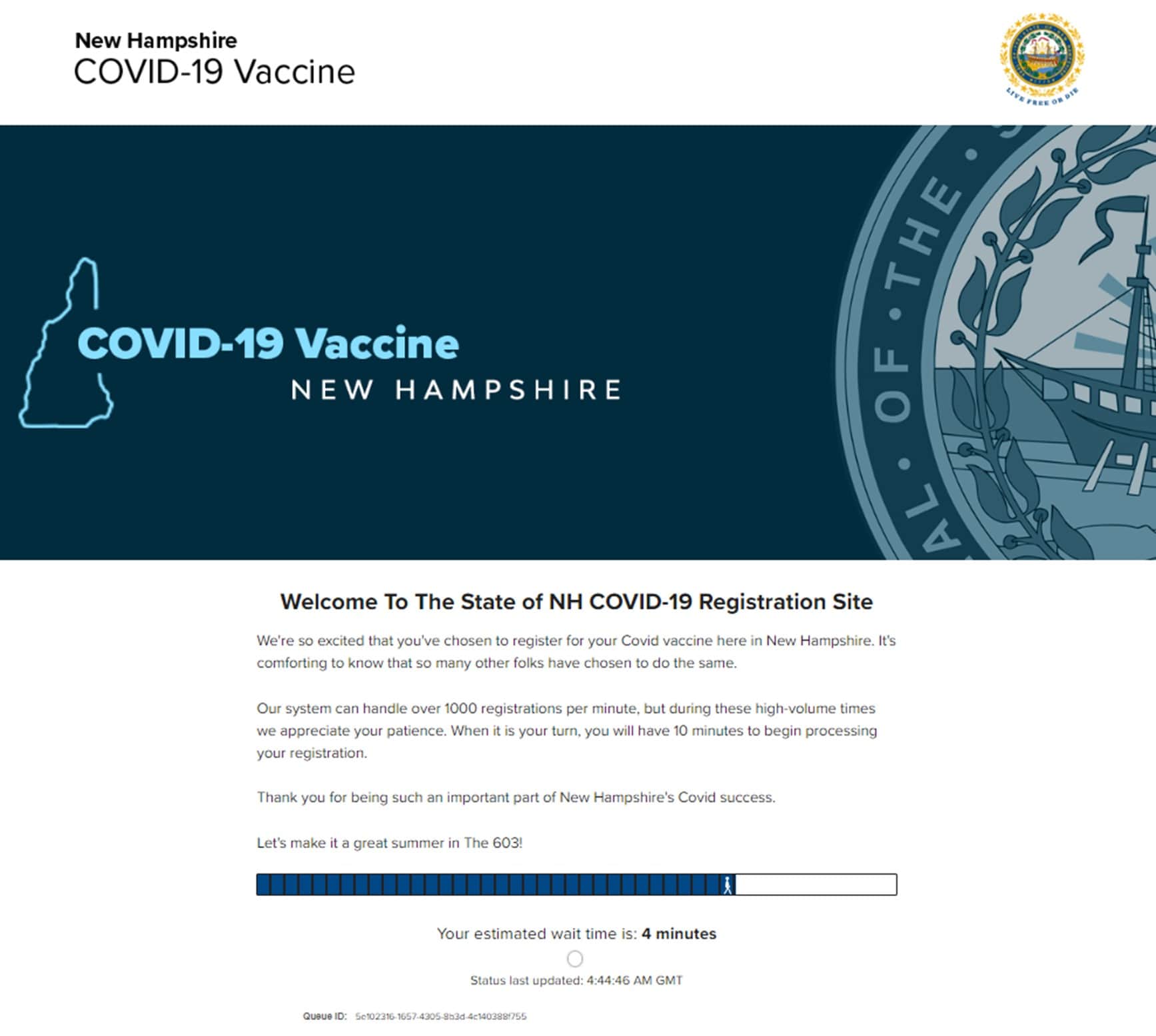
The updated announcement style meant almost no New Hampshire residents even saw the waiting room page above. Traffic to New Hampshire’s vaccine site mostly hovered around a few a hundred visitors per minute, as you can see by looking at the green line (visitor inflow per minute) in the 12-hour traffic data chart below.
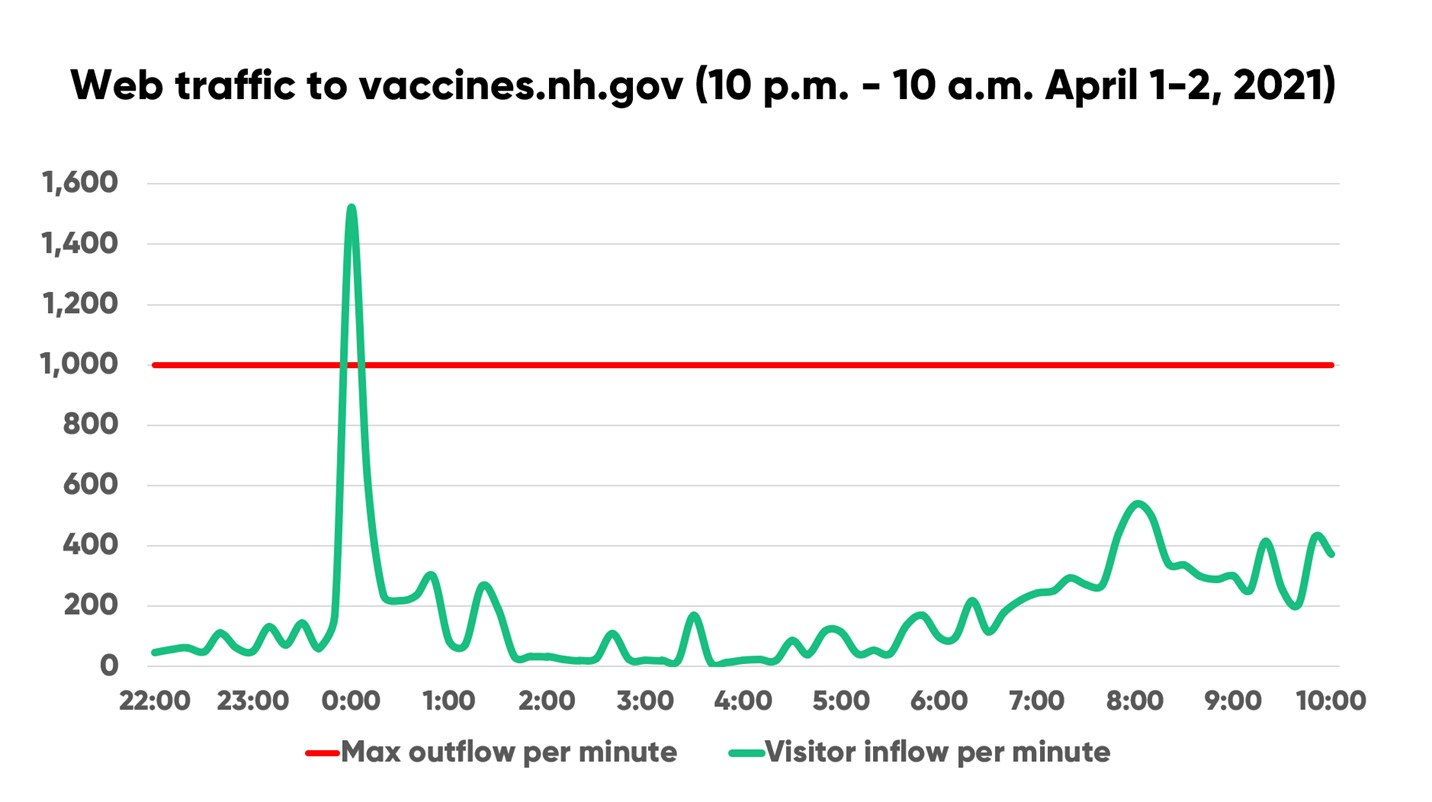
But as the chart also shows, traffic to the site remained unpredictable. And at midnight on April 2nd, traffic suddenly spiked to over 1,500 per minute. With Queue-it in place, the waiting room activated automatically, protecting the site and ensuring a seamless service experience for citizens.
“I can count on one hand the number of times in my career I've implemented a new technology and it exceeded my expectations. Queue-it is one of those times, both in how easy it is to implement, and in how well it works.”
DENIS GOULET, NEW HAMPSHIRE STATE CIO
After implementing Queue-it, Goulet quickly discovered it was much more than just an insurance policy against website crashes.
While Queue-it was implemented as a “safety net”, the real-time traffic data available in the GO Queue-it Platform came to play a crucial role in decision-making.
“What I really loved about Queue-it was the instrumentation,” Goulet says. “We were able to see traffic in the Queue-it dashboard and infer behavior from it. That was super helpful because we’d watch the traffic and see these big rushes, then we’d see it tail down to hardly anything. And when I saw that, I’d let them go live with the new age group.”
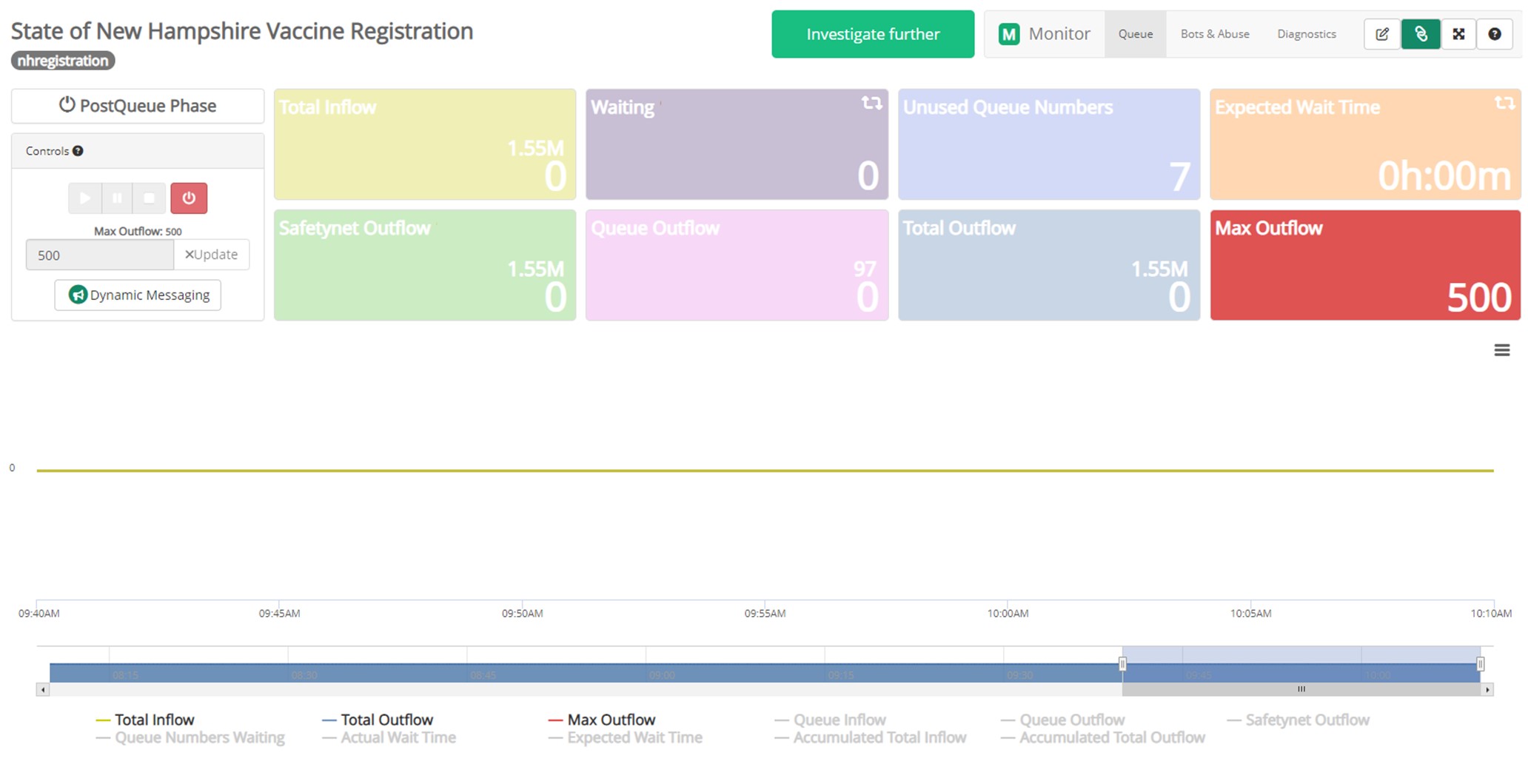
“I was the guy with the finger on the button. And because the instrumentation was so good, having Queue-it there allowed me to understand and control what was going on—that was a huge win for us.”
DENIS GOULET, NEW HAMPSHIRE STATE CIO
With the development of the VINI system, the updated announcement style, and the implementation of Queue-it, New Hampshire “quickly became one of the national leaders in vaccinations and we got unbelievably good feedback,” Goulet says.
“We became a well-oiled machine, not just in the sense of our vaccination system, but the downstream logistics of getting mass amounts of people vaccinated. We ended up doing a really good job. At a certain point, Governor Sununu even opened it up to out-of-staters to come into New Hampshire to get vaccinated.”
It was a stressful period, but Goulet looks back on it fondly, “It was all teamwork. Nobody was pursuing their own agendas. Everybody was working together for a common cause. It was amazing.”
“One thing COVID taught us is that demand for online services can be a really good thing,” Goulet reflects. “We learned that we could move much faster than we’d previously done. And I haven’t allowed our organization to backslide on that.”
In the years to come, Goulet and New Hampshire’s Department of Information Technology plan to scale their digital citizen services while improving usability. The team’s hard work on the COVID-19 vaccination registrations proved this ambition not only to be possible, but also extremely valuable.
“Our mission is to serve the citizens of New Hampshire. Our vision is to be both leaders and trusted partners. And digital transformation and providing reliable, easy to use, easy to access services is a key part of achieving that.”